

A mission worth believing in needs data worth trusting.
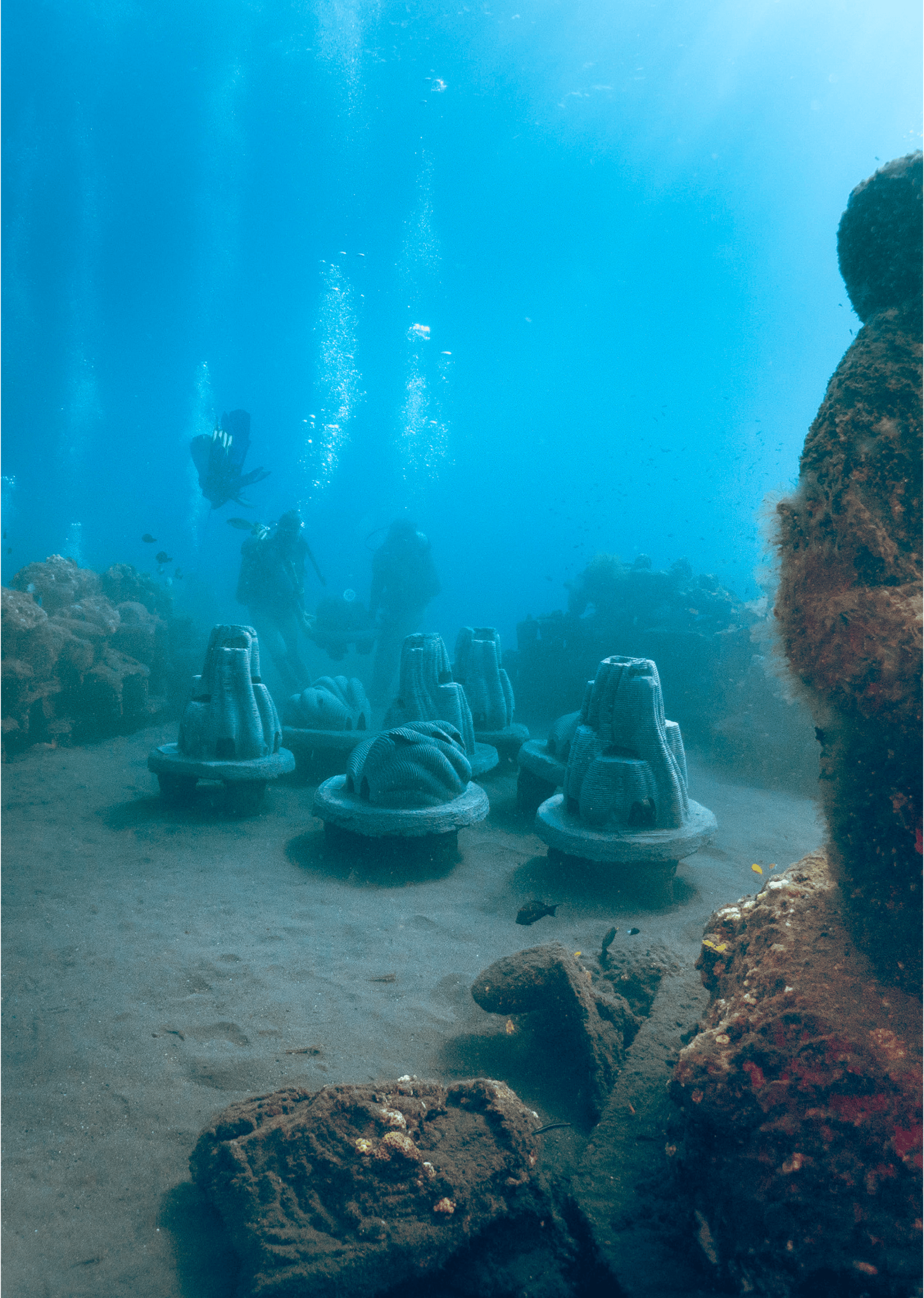
Resting Reef transforms cremated ashes into memorial ocean reefs, a genuinely circular, life-giving approach to death care. But powerful qualitative claims aren't enough when investors, stockists, and customers ask the harder question: "Can you prove it?"
Company
Resting Reef
My Role
ESG Consultant
Sector
Death Care · Circular Economy · Start-up
Focus Areas
LCA · Impact Assessment · Systems · Risk
Case Study · Resting Reef · Ongoing
The Challenge
Founded by graduates from the Royal College of Art and Imperial College London, Resting Reef had a clear and compelling vision: to redefine death care by creating living memorials that actively regenerate marine ecosystems. Every decision in the business was shaped by sustainability. But sustainability without evidence is just intention.
External Problem
No quantified carbon data meant clients, investors, and media partners couldn't compare Resting Reef's impact to conventional alternatives, making every sales conversation a 40-minute explanation.
📋
😰
🏗️
Internal Problem
The team knew their service was good, but didn't know exactly how good, or where the hidden operational risks were hiding. Confidence in their own numbers was low.
Operational Problem
A business built on integrity shouldn't have to ask customers to "trust us." Resting Reef's ethos demanded the kind of rigorous evidence their competitors couldn't offer.
Without a background in carbon accounting or lifecycle analysis, quantifying the environmental impact of the reef-making process, from cremated ash collection to reef deployment, was beyond what the founding team could build internally. They needed someone who could work at the intersection of technical rigour and business clarity.
Great values. No way to prove them.
I've seen this gap before.
Start-ups with genuine sustainability credentials often share the same frustration: their story is real, but their evidence base isn't. The impact is there, it just hasn't been measured yet. I've built carbon data systems, run lifecycle assessments, and designed impact frameworks for organisations at exactly this stage. I know what questions to ask, what data clients need, and how to build the analytical foundation without slowing the business down.
I also know that technical ESG work has to be explainable. My job isn't to hand Resting Reef a dense report and leave; it's to help them genuinely understand what the numbers mean, so they can use them confidently in every conversation that matters.
Where I came in



A structured path from qualitative claims
to quantitative confidence.
Deep Business Mapping
Before any numbers, I needed to understand the full lifecycle of the service, from cremation collection through to reef manufacture, marine deployment, and long-term monitoring. This meant working closely with the founders and their marine scientist to understand every operational component, not just the headline product.
Life Cycle Assessment (ISO 14040/14044/14046)
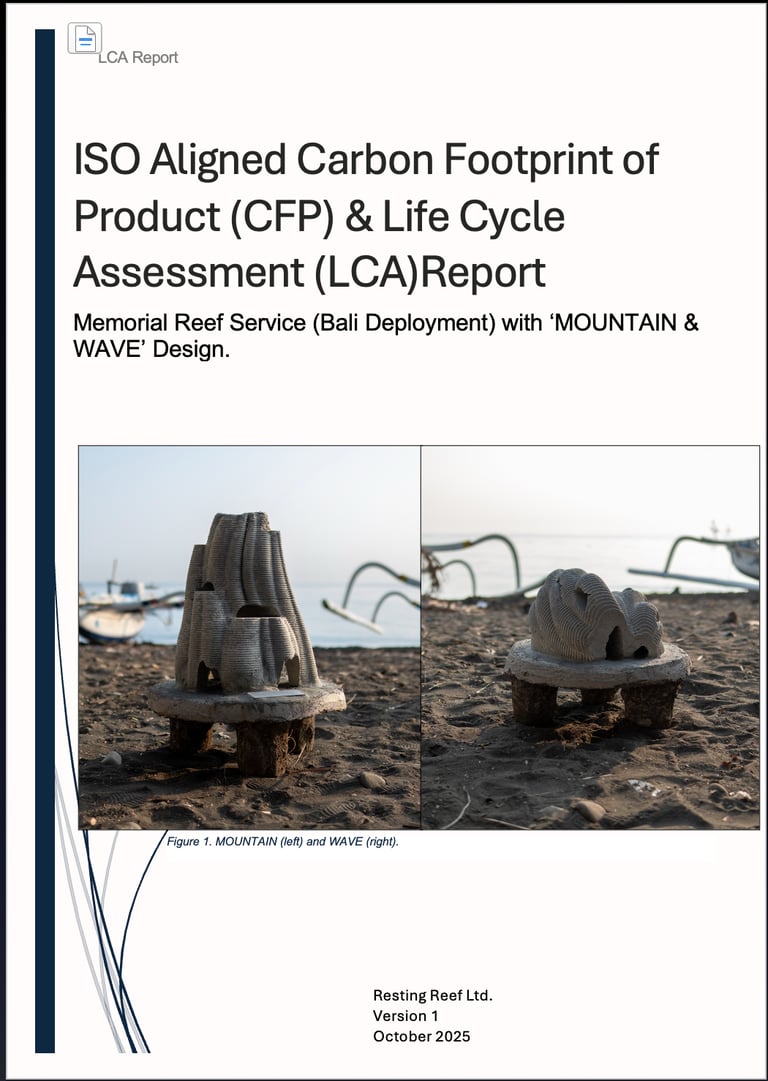
I developed a Carbon Footprint of Product (CFP) assessment aligned to ISO standards and the GHG Protocol. This meant quantifying the carbon impact (both positive and negative) at each stage of the service lifecycle, so claims about environmental benefit were verifiable, not anecdotal.
Sustainable Impact Assessment (Triple Bottom Line)
Using the People, Planet, and Profit framework, I reviewed every core business component: employee operations, design decisions, supply chain relationships, and future revenue streams; to produce a company-wide picture of impact. Both positive contributions and areas of risk were identified.
Operational Risk Review & SOPs
A start-up's biggest operational risks are often invisible until they become problems. I identified key risk areas across health & safety, service delivery, and team structure, and developed Standard Operating Procedures to address them before scale made them costly.
The Approach
1
2
3
4
Current progress
Do your sustainability claims
have the evidence to back them up?
If you're a start-up with a strong environmental story but no quantitative foundation yet, a discovery enquiry is the right starting point. We'll look at where you are, what you need, and whether I'm the right person to help.

What happens when impact businesses can't prove their impact?
What's at stake
Long, exhausting sales cycles
Spending 40 minutes on every call explaining your environmental story instead of letting the data speak for you is a conversion killer and not scalable.
⏳
📉
⚠️
🌿
Investor conversations stall
Without a quantified impact framework, investors can't model your environmental claims into their own reporting so data collection for funding rounds takes longer or goes elsewhere.
Operational risks go undetected
Start-ups focused on mission-critical goals often miss internal process risks until they've already caused disruption. Early identification is exponentially cheaper to fix.
Without ISO-aligned methodology behind your environmental claims, you're vulnerable even if your impact is entirely genuine. Evidence is your protection.
Greenwashing elimination
For a business like Resting Reef, the risks of leaving sustainability claims unquantified aren't abstract, they show up in real conversations, at critical moments.
From a story worth telling to a case worth making.
The Outcome
Faster client conversions
Comparable environmental data lets customers make informed decisions without a lengthy explanation from the founders, shortening the path from inquiry to purchase.
✦
✦
✦
✦
Investor-ready impact data
ISO-aligned LCA and impact assessment outputs that meet the evidence standards institutional and impact investors expect to see.
Confidence in the numbers
Leadership can now make strategic decisions with the understanding of their actual environmental footprint, not assumptions or estimates.
SOPs and risk frameworks give the team a shared language for how the business works, critical as headcount and complexity grow.
Operational clarity
The goal at the end of the engagement is for Resting Reef had something they didn't have before: a quantitative foundation for every sustainability claim they make. Not as a document to file away, but as a tool they use actively in client conversations, investor discussions, and internal decision-making.
Contact:
Email:


JackMurtonESG
Building the ESG foundations your future self will thank you for.