

SMEs with good intentions
and no system to prove it.
EcoVerify's clients, small and mid-sized businesses across sectors, were being asked by their larger customers and supply chain partners to prove their sustainability credentials. Most had never reported on ESG before. We helped them get there.
Company
EcoVerify
Client Types
SMEs across multiple sectors
My Role
ESG Consultant · First Employee
Focus Areas
Ecovadis · GHG · SASB · Internal Systems
Case Study · EcoVerify
The Challenge
For many of EcoVerify's clients, the trigger for engagement was a letter from a major customer or procurement team: "We require all suppliers to complete an Ecovadis sustainability assessment." For businesses with no ESG reporting history, this felt enormous.
External Problem
Clients faced losing contracts, failing bids, or being dropped from supply chains if they couldn't evidence a minimum sustainability standard, often within a tight timeline.
📋
😰
🏗️
Internal Problem
Many businesses had genuinely good practices but had never documented them. They didn't know what counted, what was missing, or how to present what they had in the way Ecovadis expected.
Operational Problem
As EcoVerify's first employee, I faced a parallel challenge: the business itself needed systems, SOPs, client workflows, scalable processes, but at the same time as client delivery was happening.
I led client engagements end-to-end and improved the system around them.
Joining EcoVerify as their first consultant hire meant learning to manage my own clients: site visits, data collection calls, document review, Ecovadis submission, and scorecard review. But I also brought something beyond the immediate project work... a habit of looking at how systems could be made better.
Within months, I identified that layering SASB Industry Standards reporting alongside Ecovadis submissions could increase environmental scorecard results across clients with minimal additional effort on their part. I also built out the client-facing SOPs that allowed EcoVerify to bring on additional consultants and scale.
Where I came in
Making Ecovadis achievable without
overwhelming clients in the process.
Client Onboarding & GAP Analysis
Every engagement began with a structured review of what the client already had, policies, handbooks, risk assessments, HR documents, emissions data. We mapped what Ecovadis needed against what existed, identifying the fastest wins and the gaps that would take more work.
Prioritised Action Planning
Rather than tackling everything at once, we sequenced work by highest impact on scoring first, building momentum with the documents most likely to unlock points early, and reserving harder-to-evidence areas for later in the process.
Carbon & GHG Reporting
For clients requiring emissions data, we built carbon footprint calculations aligned with DEFRA & GHG Protocol's reporting guidelines covering Scope 1, 2, and where applicable, Scope 3 emissions, and presented results in formats that were both Ecovadis-compatible and useful internally.
SASB Industry Standards Integration
We identified that aligning clients' reporting to SASB Industry Standards (relevant to their specific sector) created a scoring uplift on the Ecovadis environmental module with little additional client effort. I built this into the standard EcoVerify methodology.
Submission & Score Delivery
The final stage was making sure every document was correctly mapped to the right Ecovadis question, because having good material attached to the wrong section doesn't count. This matching process is where a lot of independent submissions fall down.
The Approach
1
2
3
4
5
Has your supply chain asked you to prove your sustainability credentials?
Whether you're facing an Ecovadis submission for the first time or looking to improve your score, EcoVerify can scope what's needed and build a plan that doesn't disrupt your team.
The cost of getting Ecovadis wrong, or skipping it altogether.
What's at stake
Wrong documents, wasted score
Ecovadis scores by question, not by intent. Good policies attached to the wrong section don't count and most first-time submitters don't know this until after the result.
📁
🔗
📉
🕐
Lost contracts
Larger customers and procurement teams increasingly require a minimum Ecovadis score. Missing the threshold isn't just a reputational issue it can cost real business.
Under-reporting genuine progress
Many SMEs are doing more than they realise they just haven't documented it. An unguided submission leaves real scoring potential on the table.
Not reporting where you could have started collecting data costs you a year's worth of progress. There's never a better time to start than now.
The wrong baseline
Better scores. Stronger credentials.
Less time spent explaining yourselves
The Outcome
High Ecovadis scores
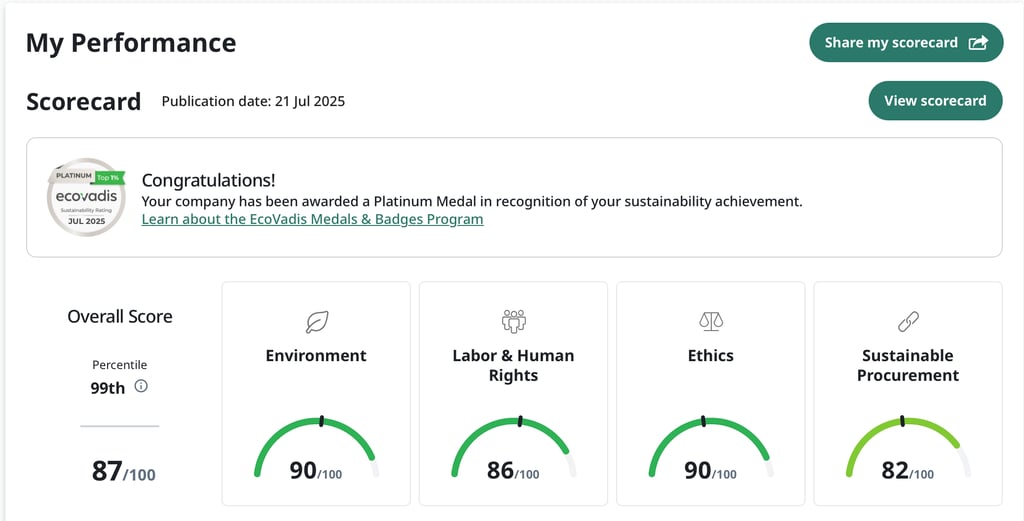
Clients achieved Gold and Platinum ratings by presenting their genuine sustainability credentials in the way Ecovadis's methodology rewards.
✦
✦
✦
✦
Environmental uplift via SASB
The SASB integration I developed increased environmental module scores across multiple clients, a meaningful improvement with limited additional workload.
Repeatable without me
Every engagement was structured so clients understood what they'd done and why, making the next cycle significantly more straightforward to manage independently.
The primary goal for most clients was meeting a supply chain requirement. The work directly enabled them to retain and win new business.
Contracts secured
Across multiple client engagements at EcoVerify, the approach consistently delivered strong Ecovadis outcomes including Platinum-level scores, while helping clients develop internal understanding that made future reporting cycles significantly less demanding.
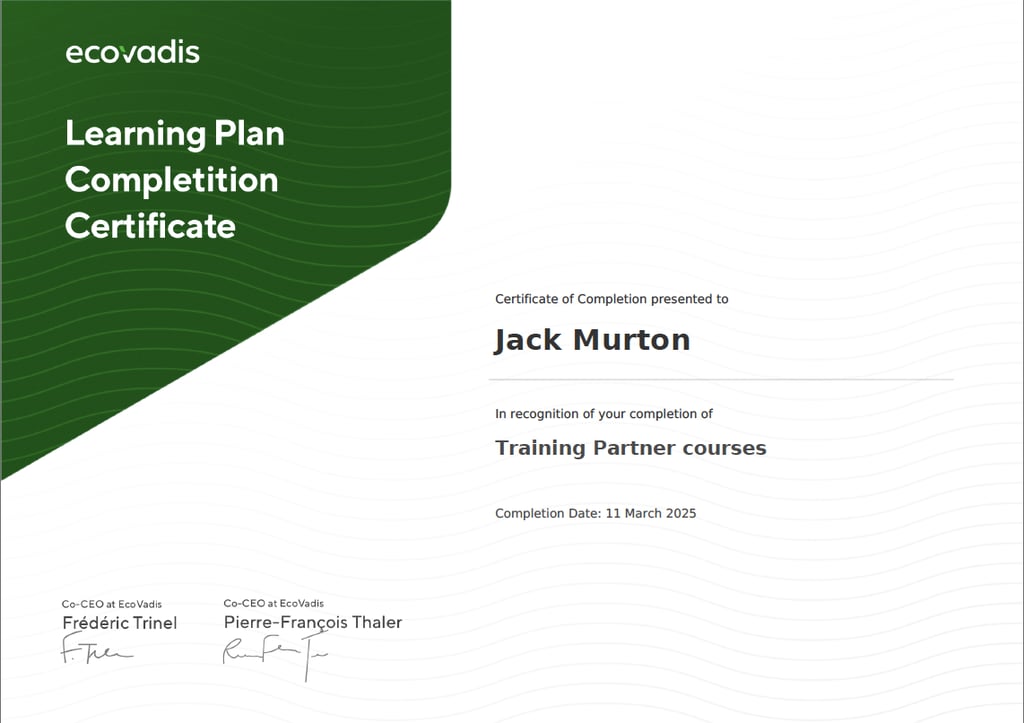
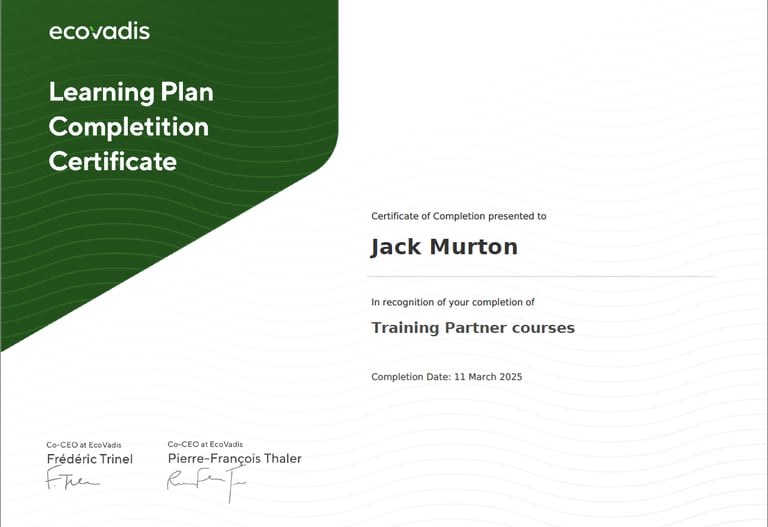
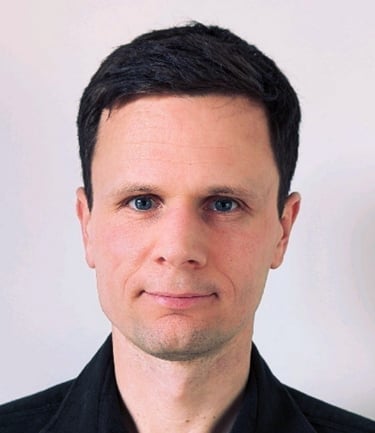
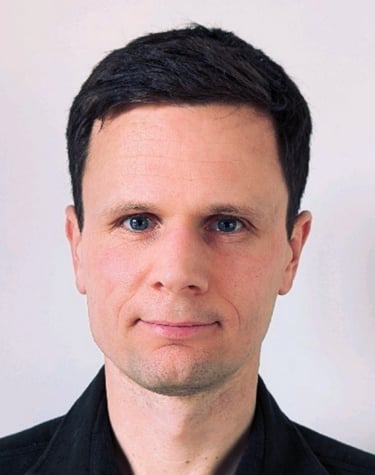
Jack demonstrates a level of wisdom and maturity far beyond his years. He is a clear-thinking, ambitious leader with a genuine thirst for knowledge and a relentless drive for self-improvement. He naturally connects with people, learns from every interaction, and thrives when given responsibility. Jack eagerly takes ownership of projects and consistently sees them through to successful completion. He is motivated by the desire to do excellent work and make a meaningful impact. I initially hired him for a junior administrative role, but he quickly surpassed all expectations—seizing the opportunity and playing a key role in driving significant growth for my business.
- Steve Bland
Contact:
Email:


JackMurtonESG
Building the ESG foundations your future self will thank you for.